Cowboys Beat Eagles 38–21: Prescott Throws Three TDs
Cowboys Beat Eagles 38–21 on Monday Night Football
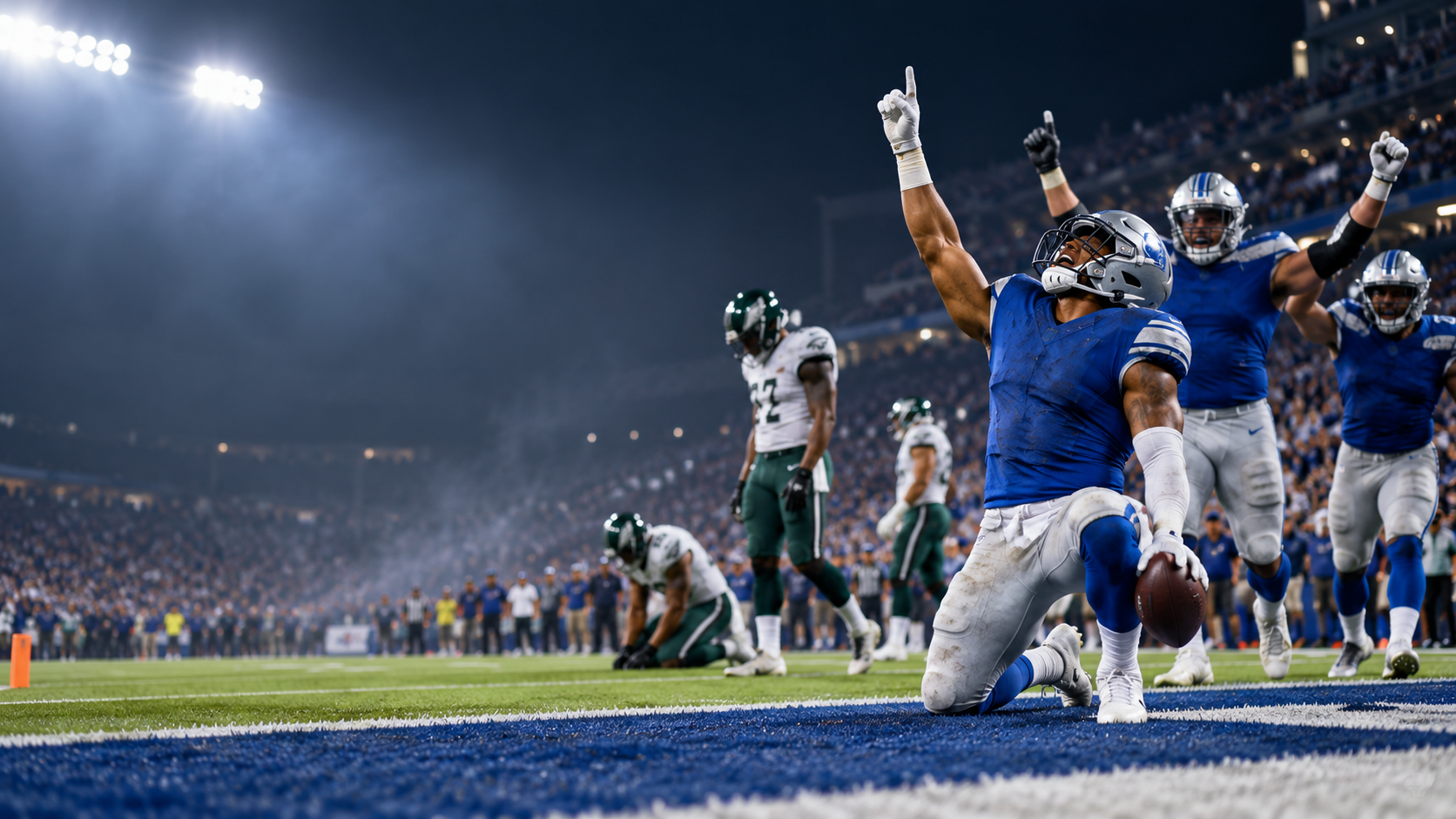
The Dallas Cowboys defeated the Philadelphia Eagles 38–21 on Monday Night Football, creating a 17-point margin in a high-profile NFC matchup. Dak Prescott threw three touchdown passes, while Dallas’ 38-point total defined the game’s offensive story. Source 1
The final score is the one fact every available report agrees on: NBC Sports reported the 38–21 result, and a second summary independently confirms the same score with Prescott’s three touchdown passes attached to it. Source 7
What the reporting does not yet supply is the mechanism behind the score — the quarter-by-quarter split, the turnover ledger, sack totals, time of possession and individual stat lines. That gap matters for how this article should be read. Everything below separates what is confirmed by reporting from what a complete box score would still have to answer, so a reader can tell which statements rest on evidence and which remain open questions.
Source hygiene is part of that separation. Several supplied entries contain no usable game information — placeholder items consisting only of a number, and unrelated topical entries — and one source identified as a FOX 4 News Dallas-Fort Worth item published October 27, 2026 at 03:51 UTC does not establish a clear connection to this matchup. Source 5 Those items cannot carry a factual claim on their own and should not be cited as if they did.
Prescott Leads Dallas’ Offense
Prescott’s three touchdown passes were the clearest individual detail from the available reports. His passing production helped Dallas reach 38 points and gave the Cowboys a decisive advantage over Philadelphia. Source 7
The supplied summaries do not include Prescott’s passing yards, completion percentage, interceptions, or touchdown targets. Those figures should be confirmed through an official box score before a complete statistical assessment is published.
Dallas’ total of 38 points indicates strong offensive production, but the available information does not establish how the Cowboys performed in the red zone, on third down, or in the running game. Those areas require further verification.
What three touchdown passes do and do not establish
Three touchdown passes establish that at least three Dallas drives ended in the end zone through the air. That is a meaningful distinction from a scoring day built on field goals, because it means the passing game converted in the area of the field where space compresses and windows tighten. It also gives the Eagles’ defensive review a fixed starting point: the passing defense conceded three scores of that type.
The number does not, by itself, explain a 38-point total. Three passing touchdowns plus their extra points account for at most 21 points, so the remaining 17 points came from scoring plays the summaries do not describe — rushing touchdowns, field goals, or defensive and special-teams scoring among the possibilities. Until the scoring summary is published, no one should attribute the full 38 points to Prescott’s arm alone.
The box score checklist for Prescott’s day
A complete assessment of the Dallas passing game requires, at minimum: attempts and completions, passing yards, yards per attempt, touchdown passes, interceptions, sacks taken, and the distribution of targets among receivers and tight ends. Efficiency context matters as much as volume — a three-touchdown day on few attempts reads differently from a three-touchdown day on heavy volume with turnovers attached.
Two further items complete the picture: how often Dallas faced third down and how often it converted, and how the Cowboys scored inside the opponent’s 20-yard line. Those drive-level numbers explain a 17-point margin more reliably than total yards, because they measure finishing rather than movement.
Eagles Fall Behind by 17 Points
Philadelphia scored 21 points but could not match Dallas’ pace. The final score confirms the result, but it does not identify whether the Eagles’ main problems involved turnovers, red-zone execution, protection, stalled drives, or defensive breakdowns.
NBC Sports Philadelphia reviewed the Eagles by position after the loss, offering a framework for evaluating the quarterback, offensive line, running game, receivers, defensive front, secondary, and special teams. The supplied summary does not include the individual grades or detailed conclusions. Source 9
A fair review should distinguish individual execution from protection, route design, blocking, and defensive communication. No player or unit should receive specific blame without verified game statistics.
How to read a position-by-position review
Each unit in that framework answers a different question. The quarterback entry addresses decision-making and accuracy. The offensive line entry addresses protection and run blocking. The running game and receivers entries address whether the skill players created yards after contact or separation. The defensive front and secondary entries address pressure and coverage, and special teams covers the field-position and kicking game.
The structure is useful because it prevents a single stat from absorbing the whole explanation. A low completion percentage, for example, can originate with the throw, the route, the protection, or the catch. Only film review plus the official stat line can separate those causes, which is why the grades belong in the record and the speculation does not.
Questions the score alone cannot answer
Four categories remain open. Ball security: whether Philadelphia lost possessions on interceptions or fumbles, and how many of those turnovers produced Dallas points. Red-zone execution: whether the Eagles converted their trips inside the 20 or settled for field goals. Protection: sack and pressure counts against the quarterback. Defensive breakdowns: explosive plays allowed and third-down conversion rate permitted.
Each of those is a discrete, checkable number. Together they would explain the 17-point gap far better than any impressionistic account of momentum.
Barkley’s Return Provides a Positive Update
Saquon Barkley said his hamstring felt “great” during his return and expressed no concern about his back, according to the available report. Source 3
The comments are encouraging but do not constitute independent medical clearance. Philadelphia should continue monitoring Barkley’s workload, acceleration, cutting, and overall response to game action. His rushing and receiving statistics were not included in the supplied summaries.
Why player-reported updates need follow-up
A player’s own description of how a hamstring and back feel is subjective evidence from the person best positioned to feel it, and simultaneously the person with the strongest incentive to project confidence. That does not make the comment unreliable; it makes it incomplete.
The objective signals arrive later: snap count, touch count, how the player is used between the tackles versus in space, and how the body responds the following day and through the practice week. Workload management for a hamstring typically tracks acceleration and cutting rather than straight-line speed, which is why a return appearance alone does not settle the question.
What the Result Means
Dallas leaves with a decisive win and a clear offensive headline: Prescott threw three touchdown passes, and the Cowboys scored 38 points. The victory demonstrates that Dallas controlled this matchup, but it does not establish long-term playoff or division outcomes without standings, schedule, and broader performance data.
Philadelphia faces a broad postgame review covering offensive consistency, quarterback efficiency, offensive-line play, ball security, defensive communication, tackling, and pass rush. Barkley’s health update is a constructive development, but the Eagles still need the complete game data to identify the causes of the 17-point defeat.
Before publication, verify the game date and season, quarter-by-quarter scoring, complete player statistics, turnovers, sacks, standings, schedules, and Barkley’s workload against an official box score or full game report. Several supplied entries contain no usable game information, and one source identified as a FOX 4 News Dallas-Fort Worth item does not establish a clear connection to this matchup.
What one result can support
A single game supports statements about that game: who won, by how many, and which headline performances drove the outcome. It cannot support claims about division standing, tiebreakers, playoff seeding, or season trajectory, because none of those are determined by one matchup and none of the required inputs — standings, remaining schedule, tiebreaker rules — are present in the supplied material.
That limit cuts both ways. Dallas’ win is a real, verifiable result and should be reported as such. It is not evidence about how the Cowboys will perform against a different opponent, and the Eagles’ loss is not evidence that any specific unit will remain a problem.
Pre-publication verification list
- Confirm the game date and season against the official schedule.
- Pull quarter-by-quarter scoring to establish how the 17-point margin accumulated.
- Collect full player statistics, including Prescott’s passing line and Barkley’s rushing and receiving lines.
- Record turnovers and sacks for both teams.
- Add standings and the remaining schedule before writing any division or playoff implication.
- Attach Barkley’s snap and touch counts to his health update.
- Drop or flag any source that carries only placeholder content or lacks a demonstrated link to this game.
Frequently Asked Questions
Who won the Cowboys–Eagles game?
The Dallas Cowboys defeated the Philadelphia Eagles 38–21.
How did Dak Prescott contribute?
Prescott threw three touchdown passes in Dallas’ 38–21 victory.
How did the Eagles perform?
Philadelphia scored 21 points but lost by 17. A complete unit-by-unit assessment requires the official game statistics and detailed reporting.
What did Saquon Barkley say about his health?
Barkley said his hamstring felt “great” during his return and expressed no concern about his back. Those comments should be treated as a player-reported update, not a medical clearance.
Can the 38 points be attributed entirely to Prescott’s passing?
No. Three touchdown passes and their extra points account for at most 21 points. The remaining scoring plays are not described in the supplied summaries and must be confirmed from the official scoring summary.
Why does the article avoid naming players or units at fault for the loss?
Because assigning blame requires verified statistics and film review. The available material confirms the score and Prescott’s touchdown passes; it does not contain the per-unit grades or individual numbers needed to support a specific attribution.
What is the single most useful next document?
The official box score. It resolves the scoring sequence, turnovers, sacks, and individual stat lines in one place, and it is the standard against which every other account of the game should be checked.
Artikel Terkait
-
 Brewers Rout Rays 10–1, Near First World Series Title
-
 Jalen Williams: Fractured Leg, Dislocated Ankle, Surgery
-
 Cowboys Defeat Eagles 38-21 in Monday Night Showdown
-
 Brewers One Win From First World Series Title
-
 5 Lessons From the Steelers' Win Over the Saints in Paris
-
 Ballon d’Or 2026: Kane and Putellas Reportedly Win