Ravens’ Third QB Exposed in 33–10 Loss to Jaguars
Ravens’ Third QB Exposed in 33–10 Loss to Jaguars
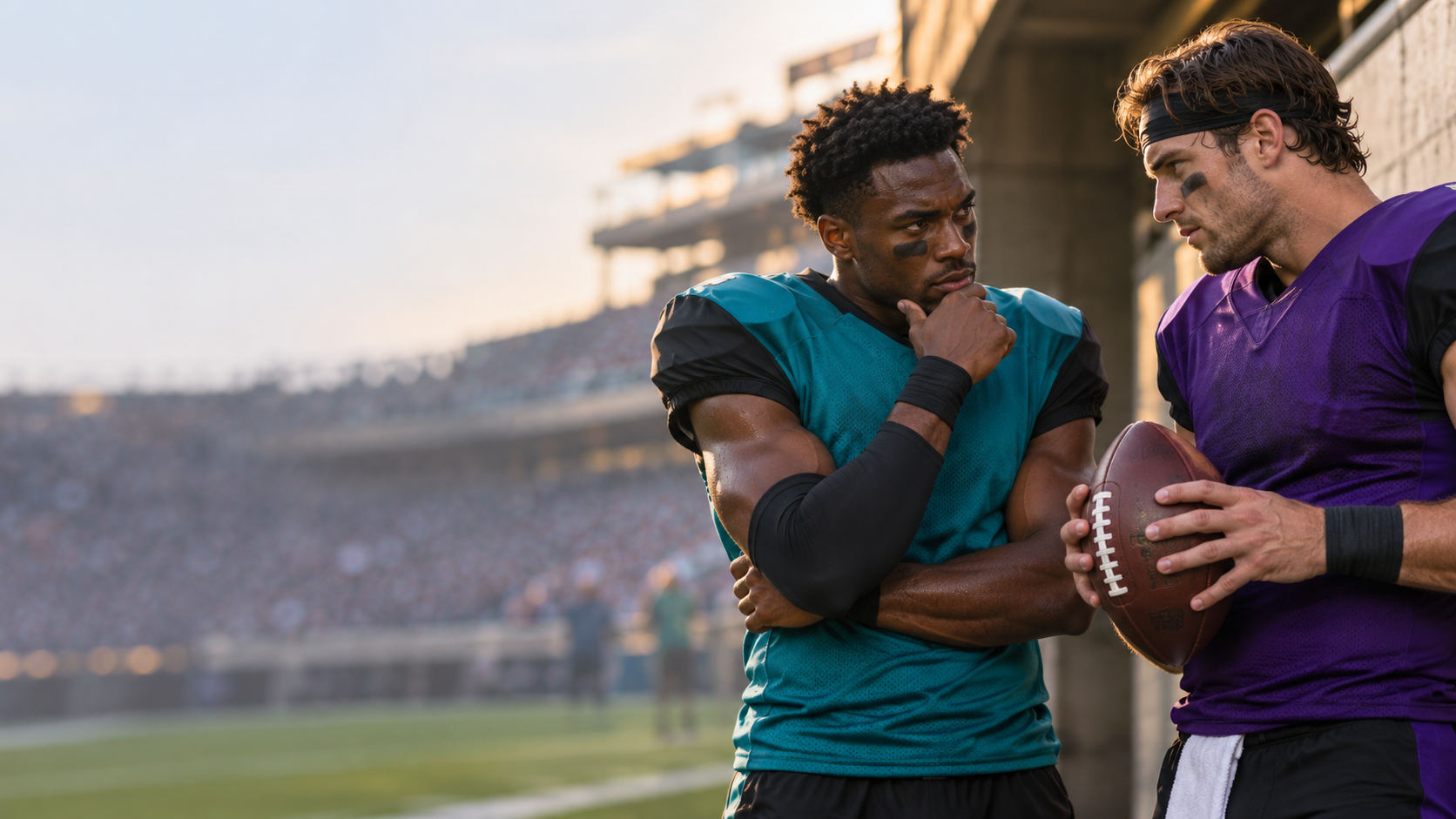
The Baltimore Ravens lost 33–10 to the Jacksonville Jaguars on Thursday Night Football, producing the type of offensive performance that becomes more likely when a team is forced to use its third quarterback.
Jacksonville controlled the game from the start, while Baltimore struggled to create rhythm, sustain drives, and remain competitive. The quarterback shortage made the Ravens’ task difficult, but it did not explain every failure in a comprehensive 23-point defeat.
Baltimore must now evaluate its pass protection, play-calling, execution, adjustments, and composure. Jacksonville did more than benefit from an injured opponent. The Jaguars built a lead, maintained control, and consistently exploited Baltimore’s limitations. Source 1
The Third-Quarterback Situation Defined Baltimore’s Ceiling
A third-string quarterback usually has fewer practice repetitions, less timing with receivers, and a smaller portion of the playbook prepared for immediate use. Coaches often respond with quick decisions, high-percentage throws, conservative reads, and protections designed to limit difficult post-snap choices.
That approach can help an offense survive, but it can also make the unit easier to defend. A reduced playbook typically includes fewer deep concepts, fewer timing-based adjustments, and fewer aggressive calls that require complete trust between the quarterback and his receivers.
Jacksonville could challenge Baltimore to throw beyond the short areas of the field, process disguised coverage, and convert difficult third downs. If the Ravens could not produce explosive plays, the Jaguars could defend with greater confidence.
The quarterback shortage also increased the importance of Baltimore’s running game and defense. The Ravens needed to avoid long-yardage situations, win field position, and keep the score close. Once Jacksonville created separation, those priorities became more difficult to maintain.
Baltimore Could Not Create Offensive Rhythm
The Ravens’ offense looked disjointed throughout the blowout. The quarterback transition likely contributed to the lack of continuity, but the result was broader than one player struggling in difficult circumstances.
A quarterback entering the lineup without a normal week of preparation must coordinate with the offensive line, running backs, tight ends, and receivers. Protection calls must be communicated correctly, route timing must be precise, and pre-snap checks must be clear. Small errors can turn manageable plays into failed possessions.
Those challenges become more severe when a team falls behind. A team trailing by multiple scores must throw more often, attempt more difficult conversions, and accept greater risk. Those are precisely the conditions most likely to expose an inexperienced quarterback.
The 33–10 deficit created a damaging cycle. Baltimore needed to become more aggressive, but that aggression required timing and execution that were difficult to produce with the third quarterback. Jacksonville could pressure the Ravens while protecting its lead.
The final box score should be used to verify possession length, third-down performance, explosive plays, red-zone results, turnovers, and passing efficiency before those categories are cited in detail. The available summaries confirm the score and poor performance but do not provide enough verified statistics for precise claims. Source 3
The Quarterback Shortage Did Not Excuse Every Failure
Baltimore’s quarterback injuries were the largest offensive constraint, but they were not a complete explanation for a 33–10 loss.
The Ravens must review whether the play-calling adapted quickly enough, whether the offensive line provided adequate protection, and whether receivers created enough separation for a limited passing attack to function. The coaching staff should also determine whether Baltimore remained committed to its most reliable run concepts or became too predictable after Jacksonville built a lead.
Penalties, turnovers, missed assignments, and failed third downs can turn a difficult quarterback situation into a blowout. Those categories should be confirmed through the official box score and game film rather than assumed from the final score alone.
A third-string quarterback may explain why Baltimore could not operate its normal offense. He does not automatically explain every missed block, poor decision, stalled drive, or defensive breakdown.
Jacksonville Turned Baltimore’s Limitations Into a Blowout
A 33–10 result indicates that Jacksonville did more than edge Baltimore in a close contest. The Jaguars controlled the game well enough to prevent the Ravens from recovering.
An early Jacksonville advantage would have forced Baltimore to pass more frequently, while the Jaguars could increase pressure and defend the run with greater certainty. That situation is especially damaging for an offense using its third quarterback. A close game allows a team to remain patient and rely on field position; a large deficit demands production outside the offense’s preferred structure.
Jacksonville could crowd short routes, force longer third downs, pressure the interior, and rotate coverage after the snap. The Jaguars could challenge Baltimore to win outside the numbers or produce explosive plays without its normal quarterback.
The precise defensive approach requires film confirmation. Claims about specific blitz packages, coverage structures, or pressure designs should not be made without a direct game report or film review.
The broader advantage was clear: Jacksonville knew Baltimore was operating under restrictions. The Jaguars could make the Ravens prove they had enough answers to escape those restrictions.
Baltimore’s Defense Could Not Keep the Game Close
The Ravens’ defense carried an unreasonable burden once the offense failed to sustain drives. Repeatedly defending after short possessions creates problems with field position, fatigue, and situational pressure.
A defense can hold an opponent down for only so long if the offense cannot provide rest or points. Jacksonville’s lead meant Baltimore could not afford ordinary mistakes. A missed tackle, penalty, or long drive became more costly because the Ravens had little offensive margin for error.
That does not make the defense blameless. A 33–10 loss is a team result. Baltimore needed stops, turnovers, or field-position wins to compensate for its offensive limitations, and it did not do enough to prevent Jacksonville from controlling the contest.
The final statistics should establish whether the Jaguars won primarily through sustained drives, explosive plays, turnovers, third-down efficiency, or short-field opportunities. Without those figures, the safest conclusion is that Jacksonville played a complete game while Baltimore failed to generate complementary football.
The Tablet Incident Symbolized Baltimore’s Frustration
Yahoo Sports reported that Baltimore’s offensive line coach threw a tablet into the rain during the poor Thursday Night Football performance. Source 7
The incident did not cause the loss, but it captured the visible frustration surrounding Baltimore’s performance. The offensive staff appeared unable to establish control, while the unit struggled to produce the consistency required to support an emergency quarterback.
A sideline outburst should not be treated as proof of internal dysfunction without additional reporting. It is better understood as a symbol of a night in which the Ravens lacked answers and could not regain momentum.
Protection Problems Increased the Pressure
Protection is especially important when a third-string quarterback plays. An experienced starter may recognize pressure before the snap, change the protection, escape a collapsing pocket, or adjust the route concept. An emergency quarterback has less room for error.
Protection breakdowns reduce the time available to process coverage. They also prevent receivers from completing developing routes and increase the likelihood of hurried throws, sacks, and negative plays.
Baltimore should review whether Jacksonville created pressure through individual blocking errors, communication problems, unfavorable down-and-distance situations, or a broader breakdown in the protection plan. Verified sack, hit, pressure, and penalty numbers will help separate those possibilities.
The team must also determine whether the offensive line was asked to protect for too long. A limited quarterback plan should include quick throws, moving pockets, play-action, and designed answers to pressure. If Baltimore repeatedly required its emergency quarterback to wait for longer-developing routes, the offense may have magnified its own disadvantage.
What the Loss Says About the Ravens
Baltimore’s Depth Was Tested at the Worst Time
Quarterback depth is partly a matter of bad luck and partly a roster-construction issue. No team can guarantee that its third quarterback will perform like a starter, but every team must prepare for the possibility that its emergency option will play meaningful snaps.
That preparation includes practice repetitions, communication procedures, a reduced emergency playbook, and clear roles for the quarterback, center, coaches, and skill-position players.
The Ravens need a clear quarterback hierarchy before the next game. The starter, backup, and emergency option should have defined responsibilities. Receivers need to know which routes and adjustments remain available, and the offensive line must understand how protections change depending on who is playing.
The immediate lesson is simple: Baltimore’s contingency plan did not produce a competitive offense against Jacksonville.
The Offense Became Too Easy to Defend
A reduced playbook can protect an inexperienced quarterback, but it must not become one-dimensional. If Baltimore repeatedly used predictable formations, short concepts, and obvious passing situations, Jacksonville could attack without exposing itself to many risks.
The solution is not to overload the quarterback with an entire starter’s playbook. It is to build a small menu that still offers variation: reliable run concepts, quick throws, play-action, motion, formation changes, and a few aggressive calls that punish defenses for crowding the line of scrimmage.
Simplification should create clarity. It should not make the offense transparent.
Composure and Execution Collapsed
The tablet incident, the 33–10 score, and the lack of offensive rhythm pointed to a team that could not stabilize after adversity. That does not establish anything about the locker room, but it does show that Baltimore failed to maintain structural discipline during the game.
The Ravens must review every execution category supported by the film and box score: assignments, penalties, third downs, turnovers, missed tackles, red-zone possessions, and drive finishes. Specific findings will be more useful than broad criticism.
Adversity exposes whether a team can preserve its fundamentals. Baltimore did not do that well enough.
What Baltimore Must Fix Next
Stabilize the Quarterback Plan
Baltimore needs a clear hierarchy and a defined emergency package for each possible option. That package should include:
- A manageable set of core plays.
- Clear protection checks.
- Reliable snap and communication procedures.
- Designed answers for pressure.
- Two-minute and red-zone packages.
- Defined practice repetitions for every quarterback.
The goal is not to make the third quarterback play like the starter. The goal is to give him a structure that allows the team to function.
Rebuild the Offensive Identity
The Ravens need an offense built around efficient early-down execution, manageable third downs, reliable run concepts, high-percentage throws, and play-action opportunities.
Protection must remain central. Baltimore cannot protect its quarterback by becoming so conservative that the defense controls every down. It must create enough formation and route variation to make opponents defend the entire field.
A functional emergency offense should reduce risk while preserving enough aggression to move the chains.
Improve In-Game Adjustments
Baltimore’s coaching staff must respond faster to pressure looks, alter formations, use motion, and find better ways to involve running backs and tight ends. Protection checks should occur earlier, and the offense should prepare counters for pressure patterns that opponents are likely to target.
Jacksonville Deserves Credit
The Jaguars’ 33–10 win was not only the product of Baltimore’s quarterback shortage. Jacksonville still had to build a lead, execute defensively, sustain its offense, and prevent the Ravens from creating a comeback.
The Jaguars capitalized on a favorable matchup without allowing Baltimore to regain control. That reflects preparation and execution. The final score also suggests that Jacksonville won the broader battle for complementary football, though the specific advantages should be confirmed through official statistics.
The supplied weather report refers to a Ravens-Jaguars game in Baltimore, but the available material contains conflicting context about the venue and conditions. Those details should be verified before publication. Source 5
Conclusion
Baltimore was placed in an unusually difficult position. Playing a third quarterback lowered the offense’s ceiling, reduced preparation time, and made it harder to adjust against Jacksonville’s defense.
That explains why the Ravens struggled, but it does not erase the warning signs. The 33–10 loss exposed problems with protection, rhythm, execution, adjustment, and composure.
Jacksonville deserves credit for exploiting those weaknesses. Baltimore must determine whether the performance was an emergency-night collapse or evidence of deeper issues. The next game will show whether the Ravens can build a functional plan around their quarterback situation before another opponent attacks the same weaknesses.
FAQ
Why did the Ravens lose 33–10 to the Jaguars?
Jacksonville controlled the game while Baltimore struggled to generate offense with its third quarterback. The quarterback shortage, poor rhythm, protection concerns, and broader execution problems combined to produce the blowout. Source 3
How much did the third quarterback affect the game?
The third quarterback likely limited Baltimore’s playbook, passing efficiency, and ability to adjust at the line of scrimmage. The situation explains much of the offensive struggle, but it does not independently account for every protection, penalty, defensive, or coaching problem.
What happened with the Ravens’ offensive line coach?
Yahoo Sports reported that Baltimore’s offensive line coach threw a tablet into the rain during the poor Thursday Night Football performance. The incident reflected the team’s visible frustration during the loss. Source 7
Did the Jaguars dominate because of Baltimore’s quarterback?
Baltimore’s quarterback situation gave Jacksonville a major strategic advantage, but the Jaguars still had to execute. Jacksonville deserves credit for creating pressure, sustaining its offense, building a lead, and preventing the Ravens from responding.
What must the Ravens fix next?
Baltimore needs a clear quarterback plan, better emergency preparation, improved pass protection, more adaptable play-calling, and cleaner execution. The team must also determine whether its offensive struggles were specific to the quarterback crisis or part of a larger structural problem.
Where can readers find the final game statistics?
Readers should consult the official box score and a direct game recap for verified passing, rushing, receiving, defensive, turnover, and third-down statistics. The available summaries confirm the 33–10 result but do not provide enough detail for precise statistical claims.